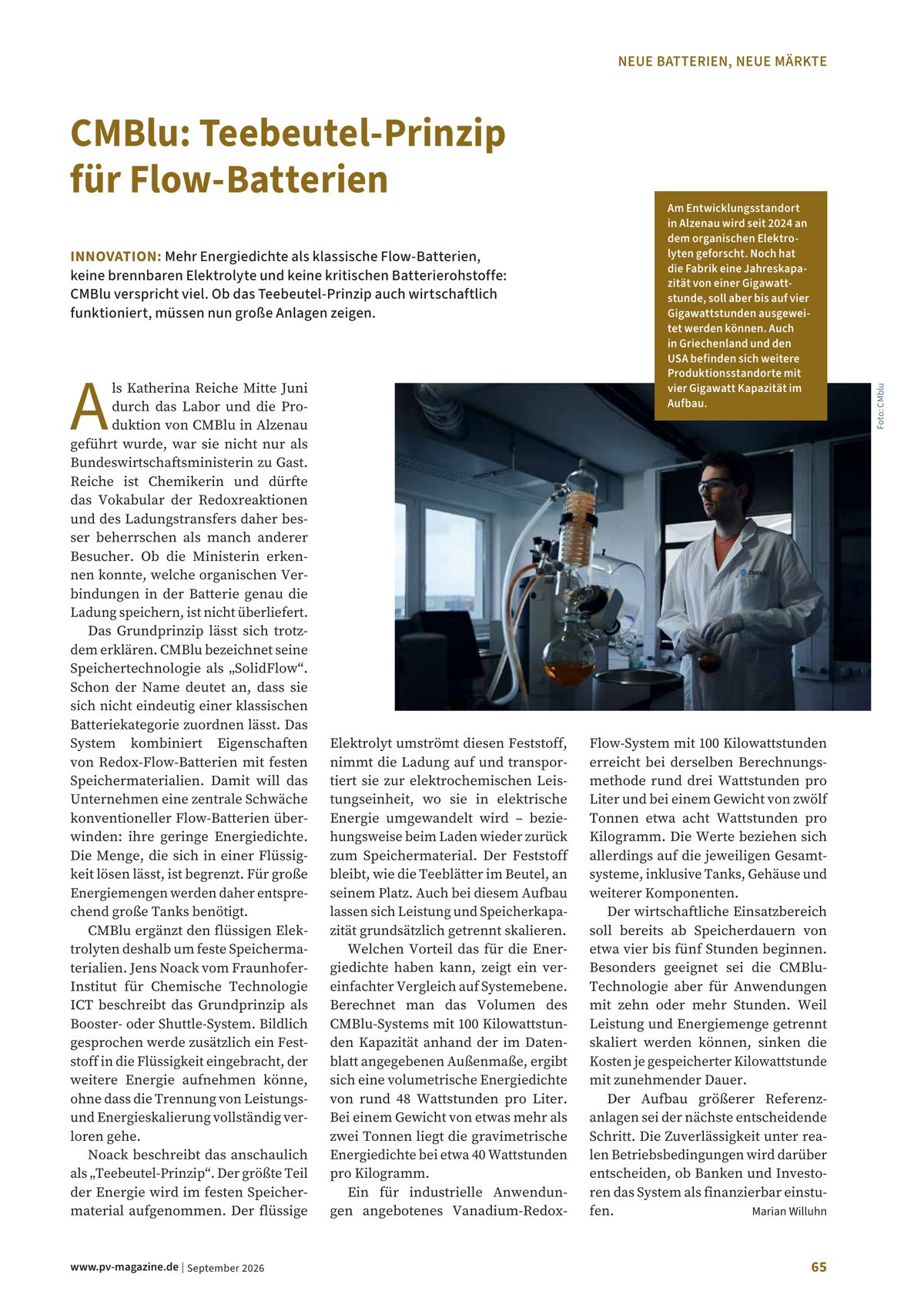
The September 2026 issue of pv magazine Germany carries two articles on flow batteries, both with explanations from Jens Noack of Fraunhofer ICT. They appeared in the section "Neue Batterien, neue Märkte" (new batteries, new markets) on pages 65 to 67.
The first article, "CMBlu: Teebeutel-Prinzip für Flow-Batterien" (p. 65), looks at the organic SolidFlow storage from CMBlu, which combines a liquid electrolyte with a solid storage material in order to raise the energy density. Noack describes the principle as a booster or shuttle system: the solid material takes up the largest part of the energy, while the liquid electrolyte flows around it, picks up the charge and carries it to the electrochemical power unit. He sums this up with the image of a tea bag, in which the tea leaves stay in place while the water passes through.
The second article, "Chemiewerk als Langzeitspeicher" (pp. 66 to 67), deals with long duration storage and with the hydrogen iron flow battery that Elestor plans for the Bürgerwindpark Zeewolde in the Netherlands. Noack, head of the energy storage systems department at Fraunhofer ICT, explains why such a system still counts as a flow battery and what distinguishes it from the vanadium technology. Power and energy can be dimensioned largely independently of each other, and components such as pumps, stacks and tanks can be replaced individually, unlike lithium ion cells, which are normally exchanged and recycled as a whole at the end of their service life. Iron is cheap and available worldwide, whereas vanadium is a critical raw material that is mostly mined outside Europe. Noack names this as an important reason for the development of alternative flow chemistries.
At the same time he cautions against expecting a cheap overall system, because the hydrogen side adds complexity: it has to handle a flammable gas and requires gas and pressure management as well as catalysts, which may include precious metals. "It sounds potentially cheap at first, because you have a very inexpensive storage medium in the iron solution", he says, "but the system makes it expensive again". As with a fuel cell, the energy carrier itself is comparatively cheap, while the technical plant for its controlled conversion accounts for a significant share of the cost.
The image shows page 65 of the September 2026 print edition, the first of the two articles (image rights: pv magazine Germany). The magazine and the articles are available from the publisher at pv-magazine.de.