New published paper: Experimental High-Throughput Electrochemistry

Experimental High-Throughput Electrochemistry

I have published a new review paper on experimental High-Throughput Electrochemistry: http://dx.doi.org/10.1002/celc.70190

Abstract: Experimental high-throughput electrochemistry (HTE) addresses fundamental limitations of classical electrochemical methods, which are often characterized by high manual effort, low experimental throughput, and limited reproducibility. By employing
parallelized and automated experimental systems in combination with advanced data analysis techniques such as Bayesian optimization and machine learning, the development and optimization of electrochemical processes and materials can be significantly
accelerated. Emphasis is placed on combinatorial approaches, automated laboratory platforms, and self-driving systems. This review presents key technologies, application areas, and methodological advances in experimental HTE, including microelectrode
arrays and robotics-based platforms. The aim is to provide a comprehensive overview of the field, bridge existing knowledge gaps, contextualize current developments, and outline future innovation pathways for experimental electrochemical research.
Although high-throughput approaches have increasingly been applied across diverse areas such as battery research, electrocatalysis, and organic electrosynthesis, a coherent methodological overview of the underlying technologies, platform concepts, and
levels of automation has been lacking. By consolidating previously scattered developments and systematically comparing different experimental strategies, this article provides a detailed picture of the current state of experimental HTE and identifies key direc-
tions for future research, particularly toward autonomous laboratory systems.

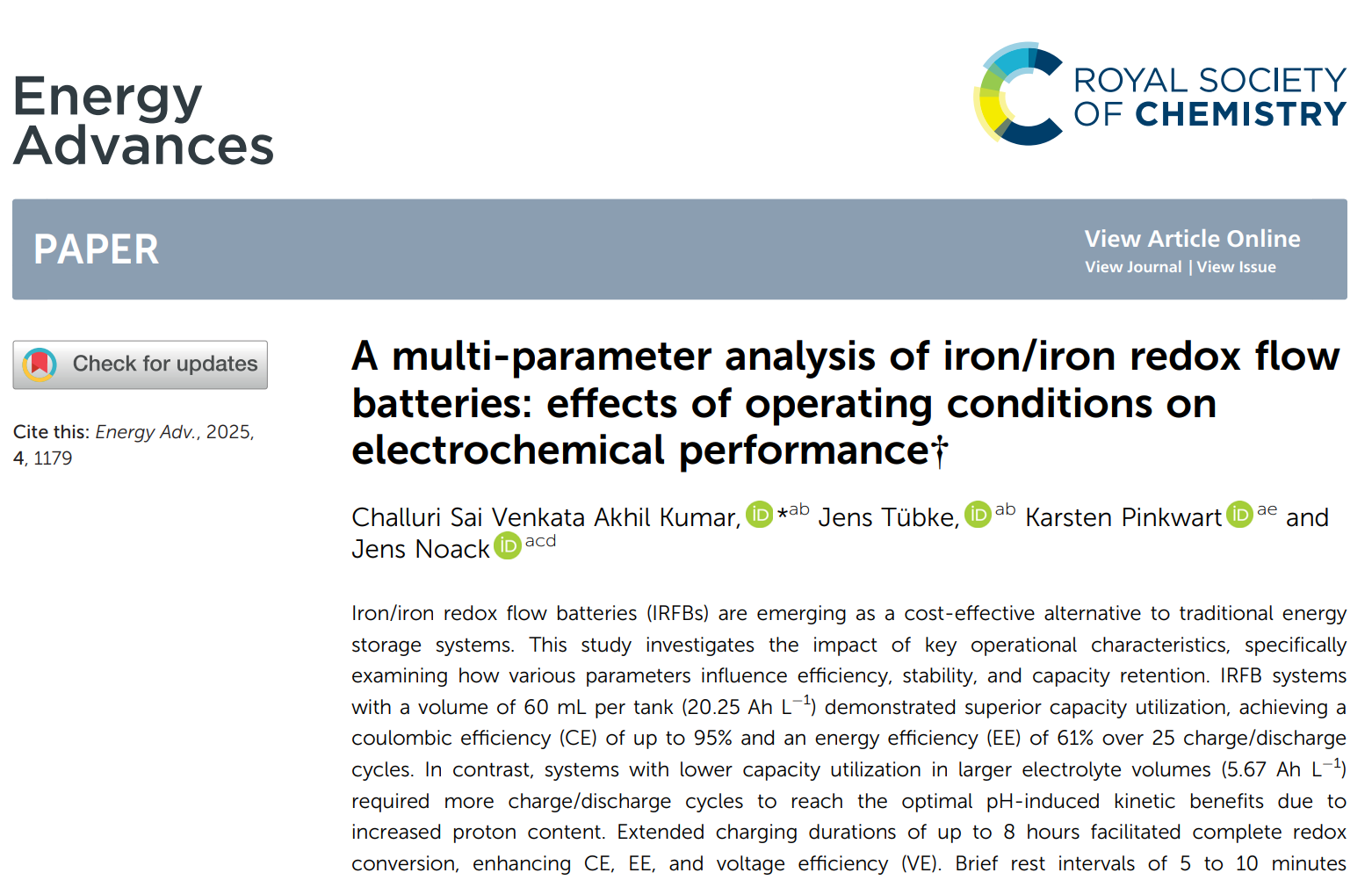
New paper published – A multi-parameter analysis of iron/iron redox flow batteries: effects of operating conditions on electrochemical performance

Challuri et al.

Iron/iron redox flow batteries (IRFBs) are emerging as a cost-effective alternative to traditional energy storage systems. This study investigates the impact of key operational characteristics, specifically examining how various parameters influence efficiency, stability, and capacity retention. IRFB systems with a volume of 60 mL per tank (20.25 Ah L−1) demonstrated superior capacity utilization, achieving a coulombic efficiency (CE) of up to 95% and an energy efficiency (EE) of 61% over 25 charge/discharge cycles.

The full article can be accessed here: https://doi.org/10.1039/D5YA00139K

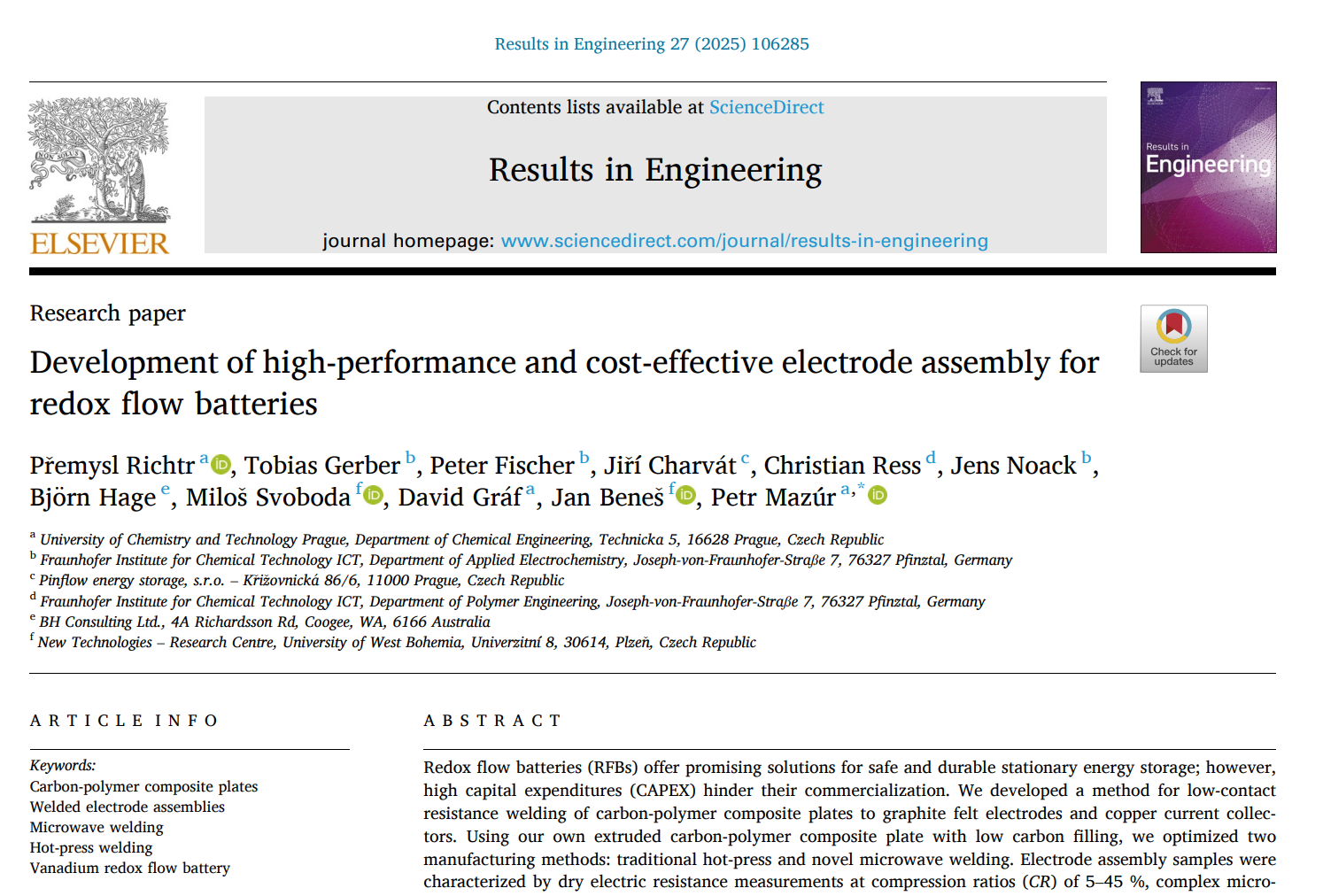
New paper published – Development of high-performance and cost-effective electrode assembly for redox flow batteries

Richtr et al. 2025

Redox flow batteries (RFBs) offer promising solutions for safe and durable stationary energy storage; however, high capital expenditures (CAPEX) hinder their commercialization.

We developed a method for low-contact-resistance welding of carbon-polymer composite plates to graphite felt electrodes and copper current collectors. Using our own extruded carbon-polymer composite plate with low carbon filling, we optimized two manufacturing methods: traditional hot-press welding and novel microwave welding.

Continue reading “New paper published – Development of high-performance and cost-effective electrode assembly for redox flow batteries”

New Paper – Adjustment of Electrolyte Composition for All-Vanadium Flow Batteries and Its Effect on the Thermal Stability of Electrolyte for Positive and Negative Half-Cells

Roznyatovskaya_2023
Roznyatovskaya_2023

https://onlinelibrary.wiley.com/doi/full/10.1002/ente.202300739

Commercial electrolyte for vanadium flow batteries is modified by dilution with sulfuric and phosphoric acid so that series of electrolytes with total vanadium, total sulfate, and phosphate concentrations in the range from 1.4 to 1.7 m, 3.8 to 4.7 m, and 0.05 to 0.1 m, respectively, are prepared. The electrolyte samples of the series for positive and negative half-cells at various state-of-charges are produced by electrolysis and are investigated for stability in the range of temperatures from −20 to +65 °C. It is attempted to reveal a correlation between initial electrolyte formulation in terms of total vanadium and total sulfate concentrations, which are measurable parameters in practice, and electrolyte thermal stability properties. The study of negative electrolyte samples by headspace online mass spectrometry enables to detect hydrogen gas, which evolves by chemical reaction of vanadium(II) species with protons during thermally induced aging. The battery with vanadium electrolyte at 1.4 m total vanadium, 4.7 m total sulfate, and 0.1 m phosphate concentrations displays more stable operation in terms of capacity decay during galvanostatic charge–discharge cycles than the battery with electrolyte at 1.7 m vanadium, 3.8 m sulfate, and 0.05 m phosphate concentrations under the same conditions.