
Dr.-Ing. Jens Noack
Scientist & Team Leader — Flow Batteries
Fraunhofer Institute for Chemical Technology (ICT) · Adjunct Associate Professor, UNSW Sydney & The University of Queensland · Deputy Director, CENELEST

Dr.-Ing. Jens Noack is a scientist and team leader for flow batteries at the Fraunhofer Institute for Chemical Technology (ICT). He is Deputy Director of the German-Australian CENELEST alliance, Adjunct Associate Professor at UNSW Sydney and The University of Queensland, and coordinator of the EU Marie Curie doctoral networks PREDICTOR and SPACER. His work covers all areas of flow batteries, from fundamental electrochemical materials research and experimental high-throughput electrochemistry, modelling and simulation, half-cell and battery tests to system development and testing.
Flow-battery materials and electrolytes
Development and evaluation of redox-active materials and electrolytes, from vanadium and iron systems to organic and hybrid approaches. Key criteria: energy density, stability, safety, resource availability.
Electrodes, cells, stacks and systems
Electrode materials, porous transport structures, flow-field design, membranes and stack design, combined with system integration for renewable-energy integration, grid support and long-duration energy storage.
High-throughput electrochemistry
Automated experimentation, spectroscopy, electrochemical characterisation and AI-supported decision-making in closed-loop discovery workflows to accelerate materials screening.
Institutes & Networks
Institutes
- Fraunhofer Institute for Chemical Technology (ICT), Germany
- Adjunct Associate Professor, University of New South Wales (UNSW), Sydney
- Adjunct Associate Professor, The University of Queensland, Brisbane
- Guest Lecturer, University of the Bundeswehr Munich
Networks
- Chairman DKE 371.0.6 “Flow Batteries”; member DKE K 371, K 384
- Member IEC JWG 7 “Flow Batteries” & JWG 82
- Founding member: Flow Battery Europe, Fraunhofer Network Australia, Australia/New Zealand Flow Battery Network
- Member: VDI, ECS, GDCh, ISE
Latest News
Current Projects
- MikroRFB — microemulsion-based electrolytes for high-performance redox flow batteries (2027–2029).
- ReBatZ — recycling of battery materials for circular flow battery systems (2026–2029).
- UltraThinFlow (UTF) — ultrathin flow cells and stacks (2026–2029).
- FLOWBOOST — boosting the performance of redox flow batteries (2026–2029).
- Rebalancing Hydrogen — iron redox flow batteries with the University of Queensland (2026–2027).
- SPACER — Marie-Curie Doctoral Network on porous electrode architectures (coordinator, started 2025).
- Beigle — stack for stationary energy storage (2025–2027).
- PREDICTOR — Marie-Curie Doctoral Network on high-throughput electrochemistry (coordinator, since 2024).
- MultiFlow — automated and sustainable mass production of RFB stacks (2024–2027).
- SMHYLES — smart hybrid multilevel energy storage systems (2024–2027).
- Boron-Based Energy Transition — German-Brazilian cooperation (BMBF/CNPq).
Newest Publications
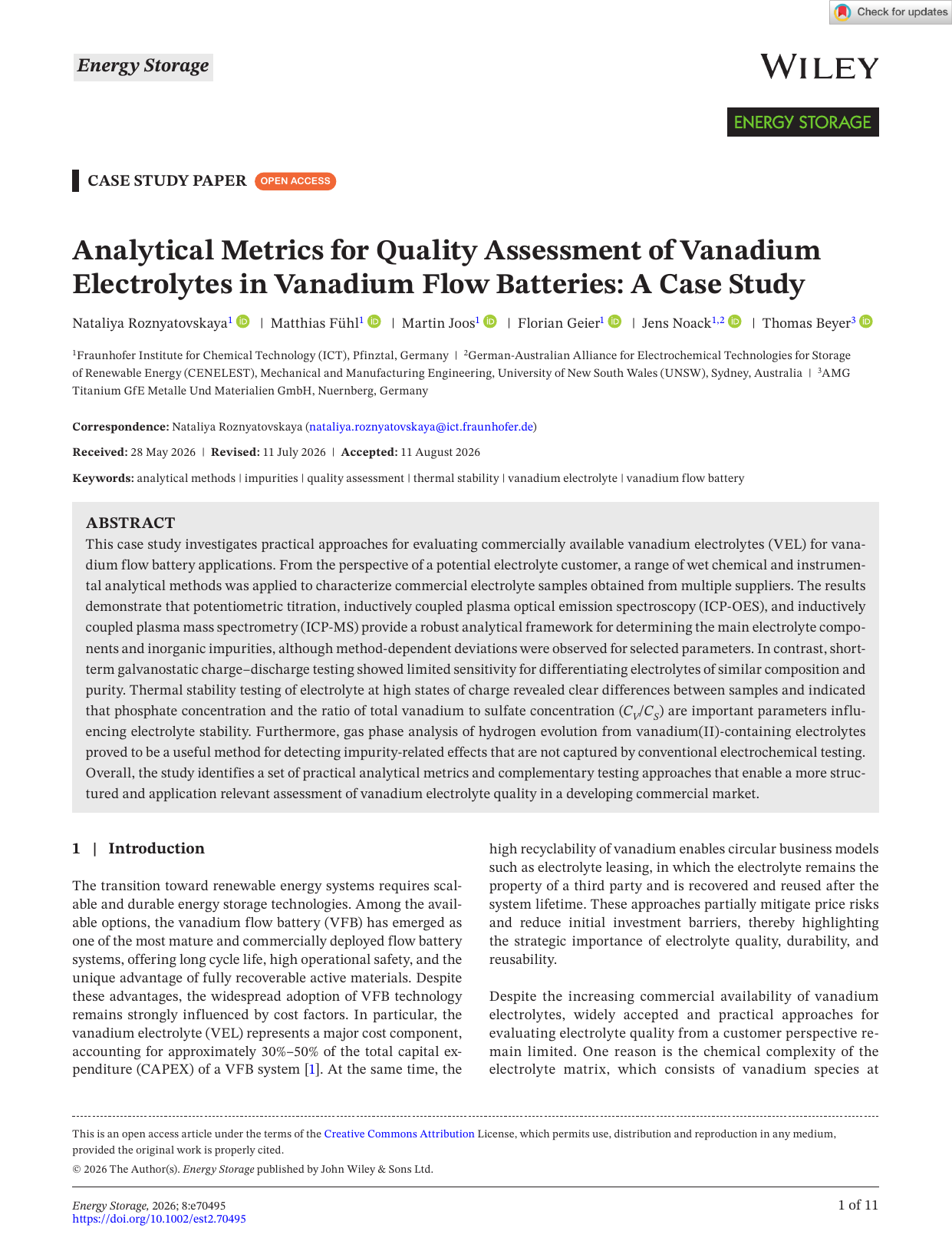
Analytical Metrics for Quality Assessment of Vanadium Electrolytes in Vanadium Flow Batteries: A Case Study
N. Roznyatovskaya, M. Fühl, M. Joos, F. Geier, J. Noack, T. Beyer, Energy Storage, 8, 6, e70495, 2026. https://doi.org/10.1002/est2.70495
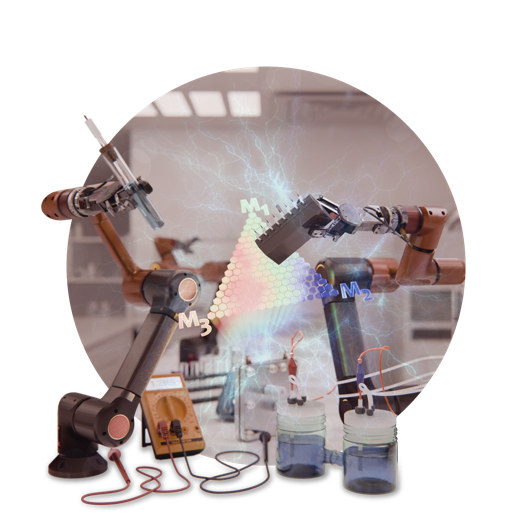
Experimental High-Throughput Electrochemistry
J. Noack, ChemElectroChem, 13, e70190, 2026. https://doi.org/10.1002/celc.70190

Effects of operating temperature on kinetics and performance of iron/iron redox flow batteries
A. Challuri, A. De, H. Weyrauch, J. Tübke, J. Noack, Energy Advances, 2026. https://doi.org/10.1039/D6YA00077K
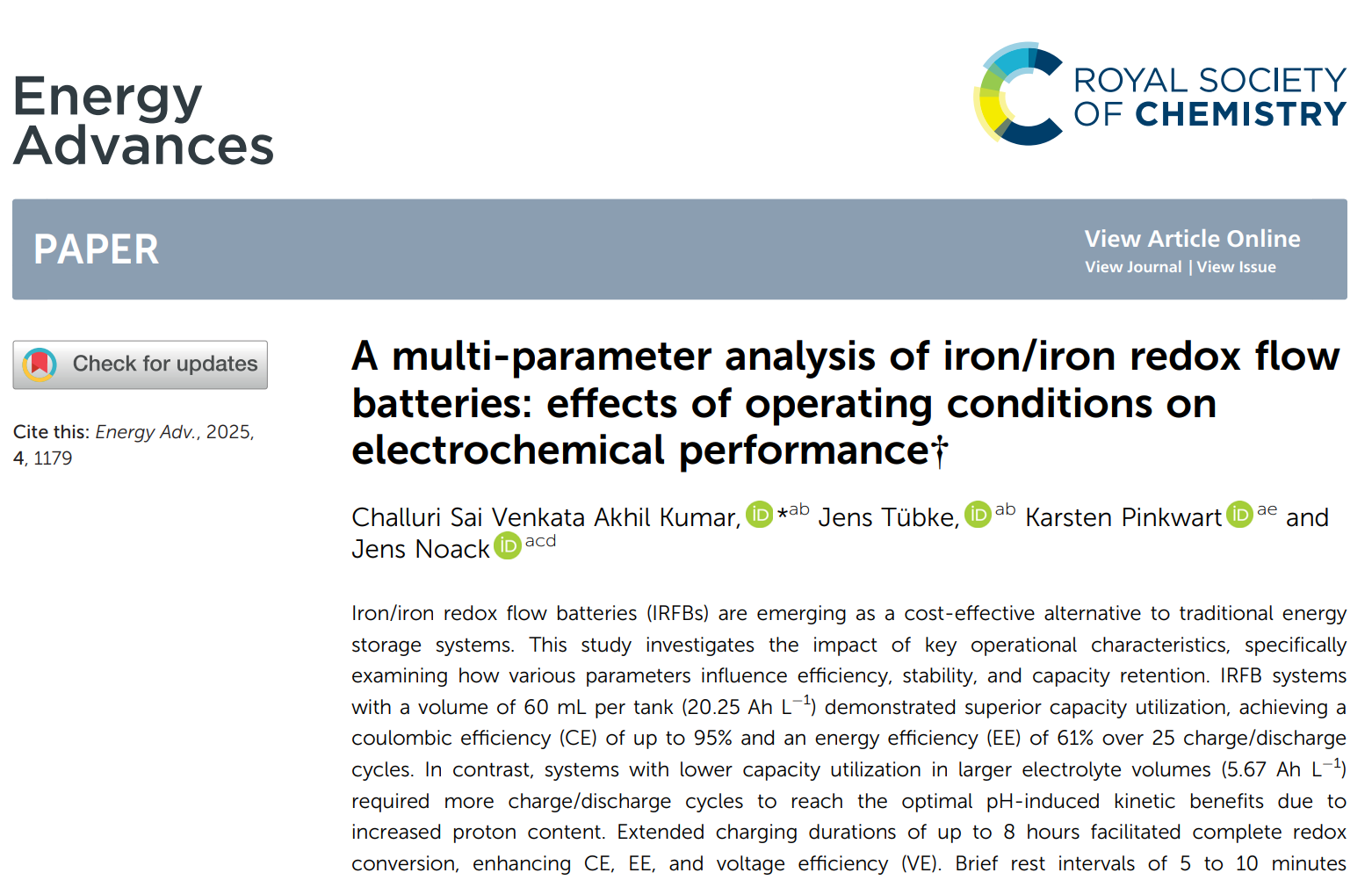
A Multi-Parameter Analysis of Iron/Iron Redox Flow Batteries: Effects of Operating Conditions on Electrochemical Performance
A. Challuri, J. Tübke, K. Pinkwart, J. Noack, Energy Advances, 4, 1179–1200, 2025. https://doi.org/10.1039/D5YA00139K
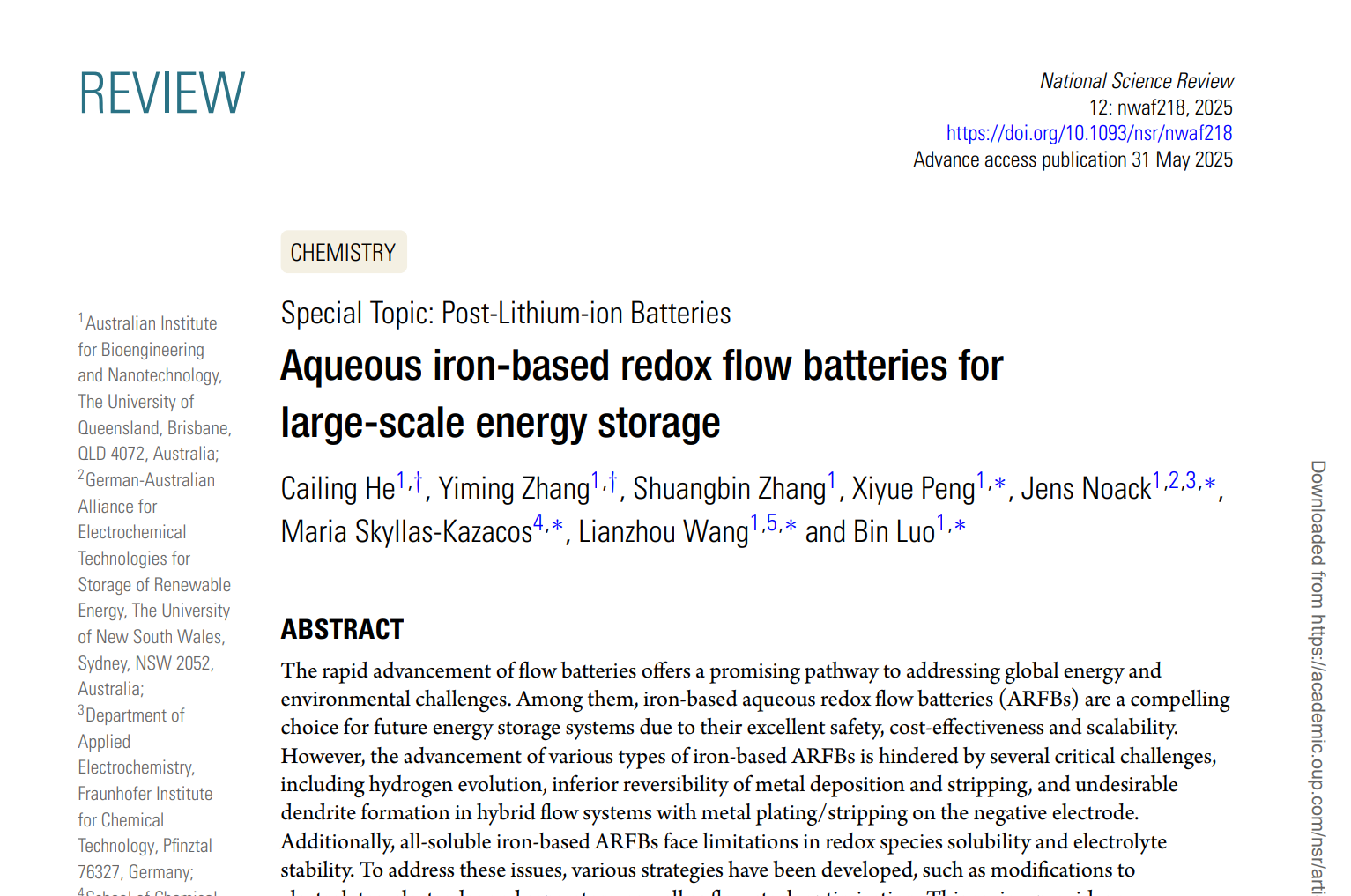
Aqueous iron-based redox flow batteries for large-scale energy storage
C. He, Y. Zhang, S. Zhang, X. Peng, J. Noack, M. Skyllas-Kazacos, L. Wang, B. Luo, National Science Review, 12, 7, 2025. https://doi.org/10.1093/nsr/nwaf218
Applied Research & Technology Transfer
Research at the Fraunhofer Institute for Chemical Technology is application-oriented: from fundamental electrochemistry to industrially relevant flow battery systems. Close cooperation with universities and industry — including the MoU between Fraunhofer ICT and The University of Queensland (2023) — and active standardisation work in DKE and IEC committees ensure that results find their way into practice.
Get in Touch
Questions about redox flow batteries, cooperation or research opportunities? Contact me via the contact form.