
The IEC New Work Item Proposal “Electrolyte for vanadium flow batteries” has been accepted by all of the members, which means that we will start developing a new international standard for vanadium electrolyte in IEC: https://www.iec.ch/ords/f?p=103:38:13392960990367::::FSP_ORG_ID,FSP_APEX_PAGE,FSP_PROJECT_ID:1290,23,122658#
Visit of EU Energy Commissioner and Australian Minister for Climate Change and Energy
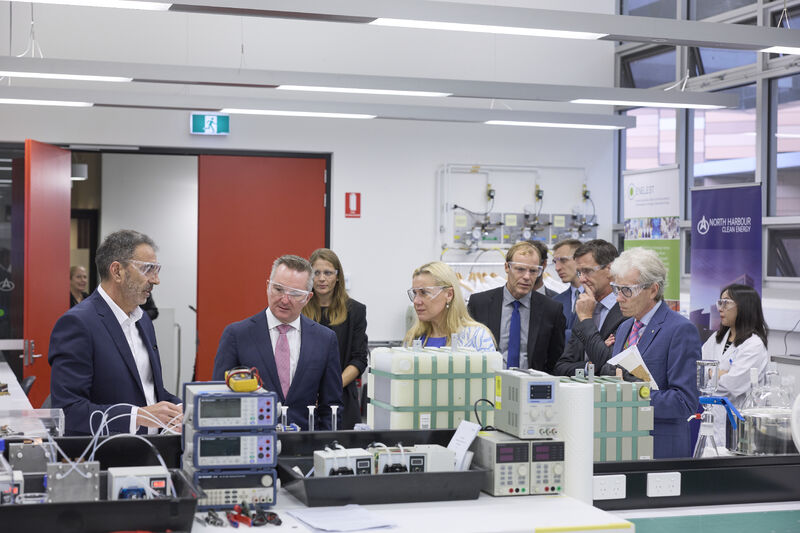
European Union Energy Commissioner Kadri Simson and the Hon Chris Bowen MP, Australian Minister for Climated Change and Energy toured UNSW, including a visit of CENELEST redox flow battery research facilities.
CENELEST attends SMART Energy 2024
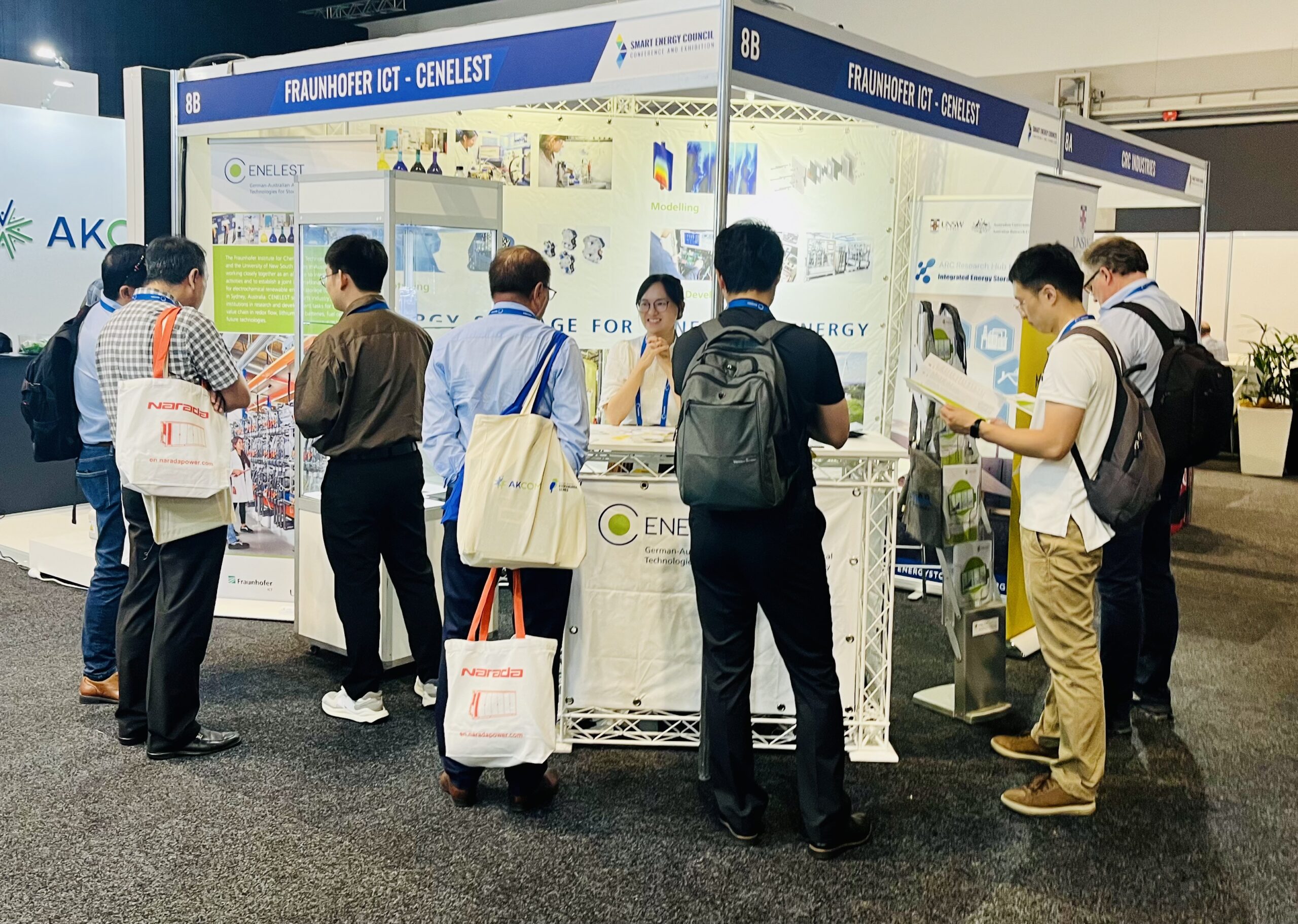
This week, CENELEST took part in the Smart Energy Expo and Fair at the Conference Center in Sydney with an exhibition stand. Various participants presented to visitors what CENELEST is and can do for the research and development of redox flow batteries. The results of projects carried out with CENELEST were also presented. Smart Energy in Sydney is one of the largest trade fairs in Australia in the field of renewable energies and stationary energy storage.
New Paper – Adjustment of Electrolyte Composition for All-Vanadium Flow Batteries and Its Effect on the Thermal Stability of Electrolyte for Positive and Negative Half-Cells

https://onlinelibrary.wiley.com/doi/full/10.1002/ente.202300739
Commercial electrolyte for vanadium flow batteries is modified by dilution with sulfuric and phosphoric acid so that series of electrolytes with total vanadium, total sulfate, and phosphate concentrations in the range from 1.4 to 1.7 m, 3.8 to 4.7 m, and 0.05 to 0.1 m, respectively, are prepared. The electrolyte samples of the series for positive and negative half-cells at various state-of-charges are produced by electrolysis and are investigated for stability in the range of temperatures from −20 to +65 °C. It is attempted to reveal a correlation between initial electrolyte formulation in terms of total vanadium and total sulfate concentrations, which are measurable parameters in practice, and electrolyte thermal stability properties. The study of negative electrolyte samples by headspace online mass spectrometry enables to detect hydrogen gas, which evolves by chemical reaction of vanadium(II) species with protons during thermally induced aging. The battery with vanadium electrolyte at 1.4 m total vanadium, 4.7 m total sulfate, and 0.1 m phosphate concentrations displays more stable operation in terms of capacity decay during galvanostatic charge–discharge cycles than the battery with electrolyte at 1.7 m vanadium, 3.8 m sulfate, and 0.05 m phosphate concentrations under the same conditions.
SONAR final meeting in Karlsruhe
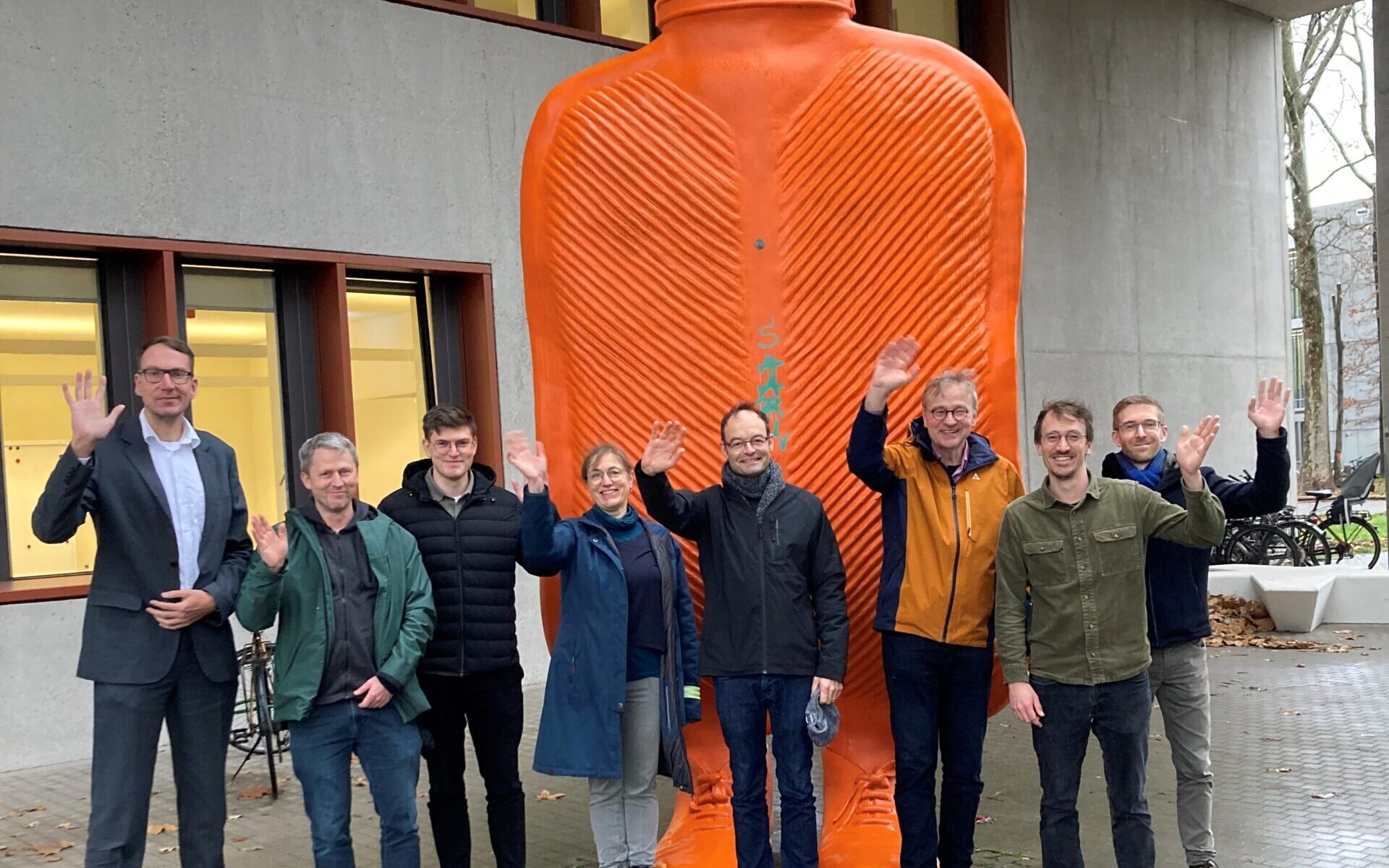
The final meeting of the EU project SONAR took place on 13.12.23. As a reminder: In SONAR, seven different research institutions worked on the development of a computational high-throughput screening process for novel organic active materials for redox flow batteries. The demonstrator is available at https://redoxfox.scai.fraunhofer.de. We will provide a final version of the project website at https://www.sonar-redox.eu. In other words, we will now reorganize it somewhat and have already started to do so, so that information and results from the individual SONAR participants will be available.
Finally, and very importantly, the Fraunhofer SCAI is now offering a service for all interested parties as a point of contact for the developed screening process. In principle, the screening is not limited to redox flow batteries, but can ultimately be adapted for all organic materials with specific properties, especially for other battery types.
It has been a special honor for me to coordinate this very interesting project over the last four years with these extremely professional and outstanding partners.